

Auger Electron Spectroscopy (AES) is a widely used analytical technique for determining the elemental composition of solid surfaces. Its key advantages include high surface sensitivity (0.4 to 5 nanometers), rapid data acquisition, detection of all elements above helium, and high spatial resolution. It is particularly valued for its high spatial resolution, making it ideal for analyzing small features.
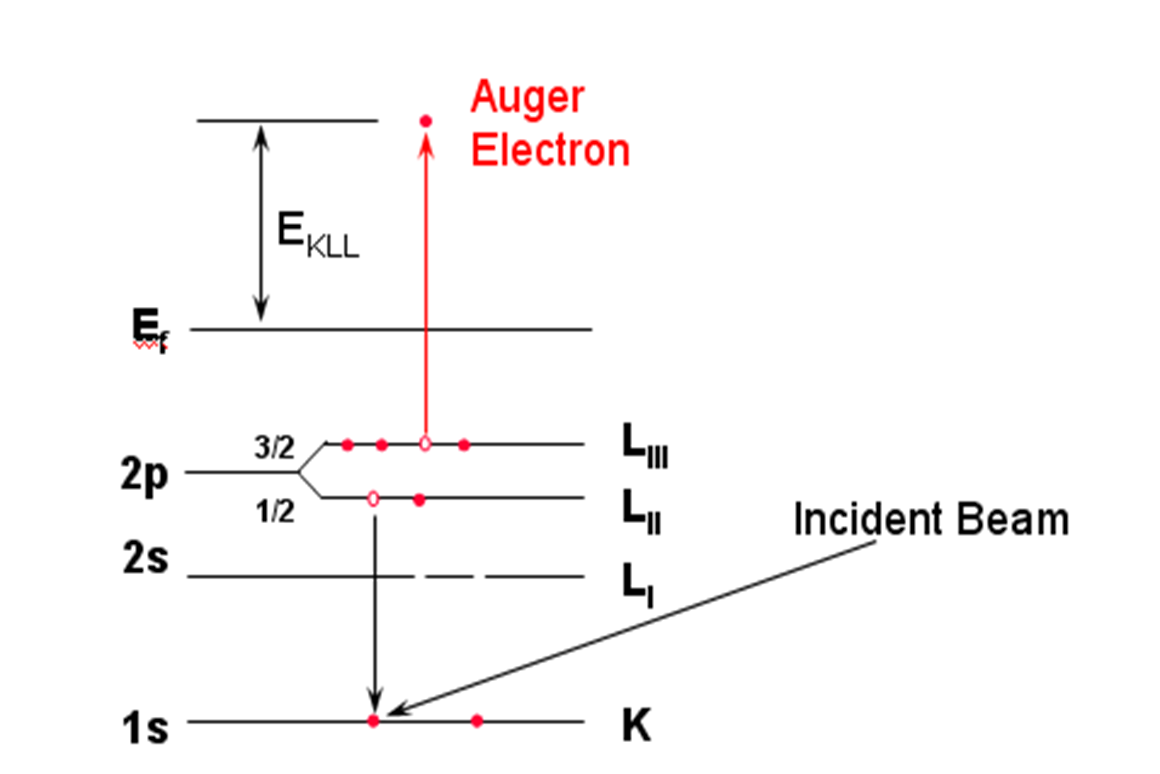
The Auger effect is a three-electron process, a phenomenon discovered by Pierre Auger in 1923.When an electron beam strikes a sample surface, it ejects a core-level electron from an atom, creating a core hole. An electron from a higher energy level falls down to fill this hole. The energy released during this relaxation is transferred to another electron in a higher energy level, which is ejected as an Auger electron.
The kinetic energy of the Auger electron is characteristic of the emitting atom and depends on the energy differences between atomic energy levels, not on the energy of the incident beam.